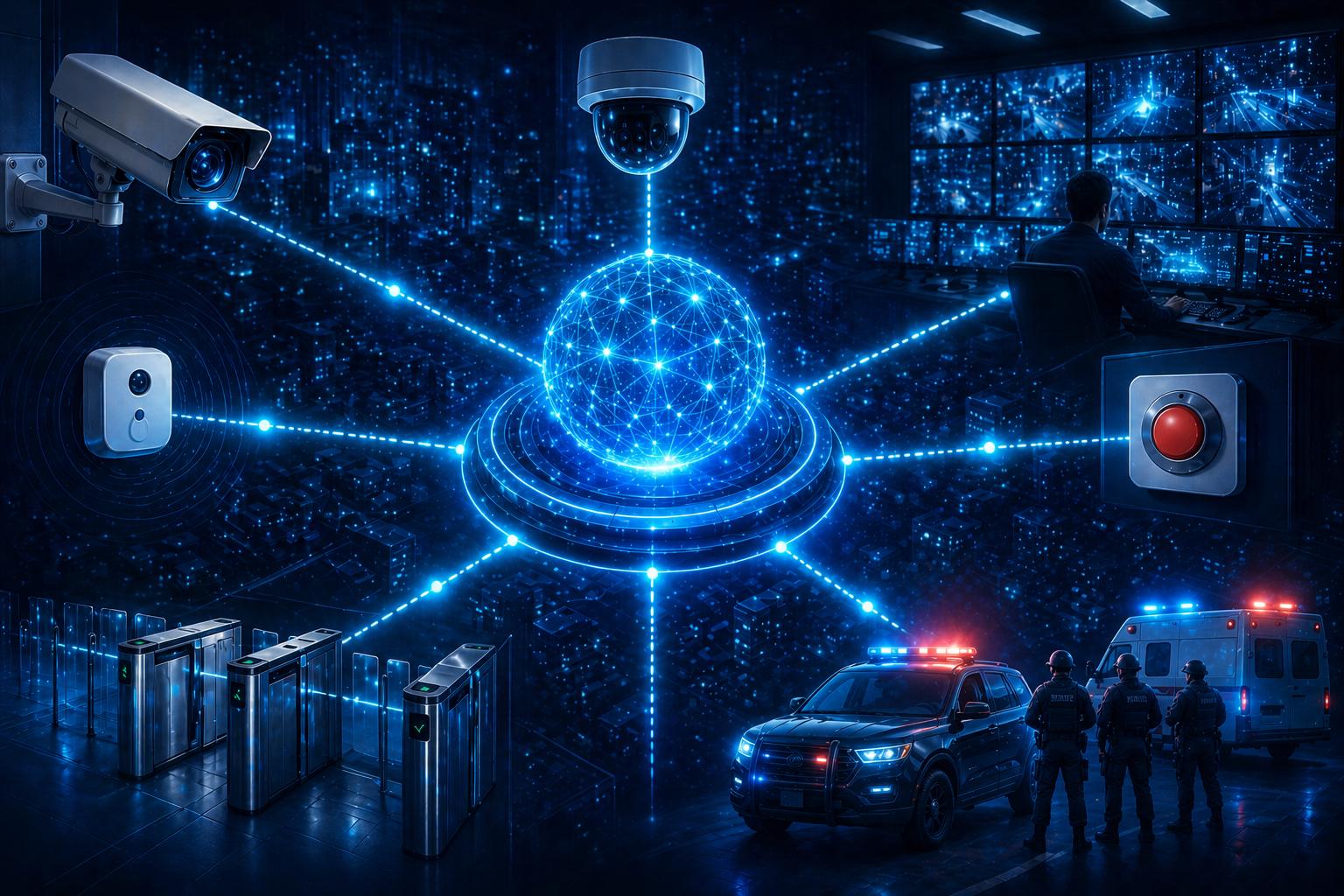
You have a room full of top-tier security equipment. Advanced cameras from every leading manufacturer. Smart access control systems. Sensitive perimeter sensors. Everything’s connected, everything works, and the budget? You spent plenty.
So why, when something happens, does no one know what to do?
Why is the security team calling in a panic asking “What am I supposed to be seeing right now?” Why does every incident turn into chaos with people trying to figure out which camera shows what, who’s supposed to respond to which alarm, and how to coordinate between different systems?
The answer is simple: you have technology. You don’t have integration.
The Problem No One Talks About
Let’s talk straight: most urban or corporate security projects start at the same point – a shopping list of equipment. “We need 50 cameras. We need access control for 12 gates. We need sensors for the entire perimeter.”
Then the vendor comes, installs everything, gives a two-hour training on how to operate each system separately, and disappears over the horizon.
What’s left? Disconnected systems where each one does exactly what it’s supposed to do – but doesn’t talk to the others. A security team that needs to navigate between ten different interfaces. And emergency situations where critical information simply doesn’t reach the right people in time.
This isn’t equipment failure. This is planning failure.
What Does "Integration" Really Mean?
When we say integration, we’re not talking about “connecting everything to the same server” or “showing everything on the same screen.” That’s not enough.
True integration means three things:
- Real-Time Situational Awareness When something happens, everyone who needs to know, knows. No searching, no asking, no guessing. The right information reaches the right people at the right moment.
- Fast Decision-Making There are clear processes. Every incident is routed to the right person, with all the information they need to decide what to do. No confusion, no searching, no “hold on, I’m checking.”
- Coordination Between Elements Security, maintenance, management, external forces – everyone works from the same information, coordinated, knowing everyone’s role. This isn’t lucky timing, it’s planning.
And all of this starts long before you buy the first piece of equipment.
How It Fails: Four Warning Signs
If you’re seeing these in your organization, you have an integration problem:
Sign 1: Security team spends more time navigating between systems than responding to incidents
Five different screens, seven interfaces, ten passwords. Every time something happens, you need to remember which software displays it, how to log in, and how to find the relevant information. By the time you find it – the incident has passed.
Sign 2: Incidents “fall through the cracks”
An alarm triggered in Sector B, but the person responsible for the sector didn’t get an alert because they’re not connected to that system. Or they got an alert but didn’t know it was critical because there’s no defined priority scale. Or they knew it was critical but didn’t know who to pass it to.
Sign 3: “We need more people”
The solution to every problem is “let’s add another person to the control room.” Because instead of technology working for people, people work for technology – operating it manually, searching for information, passing messages.
Sign 4: In hindsight, there’s always information that could have helped
“Wait, we had footage of this?” “Why didn’t anyone see this alarm?” “But this system was supposed to alert!” The information was there. It just didn’t reach the right place.
These aren’t signs of a weak team. These are signs of a system that wasn’t designed to work together.
What Should Be: A Command Center That Works
A command and control center isn’t a room with lots of screens. It’s the brain of the entire security operation – where information becomes action.
But most centers weren’t designed that way. They were designed as places to display all systems nicely. The difference is critical.
A properly designed command and control center does three things:
Centralizes Information, Not Systems – The security team doesn’t need to know which system tracks what. The center takes information from all sources and presents it in a way that answers “what’s happening now?” Not “what does camera 17C show?” but “is there a threat in the parking lot?”
Manages Processes, Not Just Displays Data – Every incident type knows where it goes, who’s responsible, and what the next steps are. This doesn’t depend on someone’s memory. This is security engineering built into the system.
Connects to the Real World – The command center doesn’t exist in a bubble. It communicates with external security forces, emergency teams, management. Information flows outward just as it flows inward.
And none of this happens by accident. It requires planning that starts with understanding what the organization actually needs.
Tandu's Methodology: From Equipment to Ecosystem
At Tandu Security Consulting, we don’t start with an equipment list. We start with a completely different question: what needs to happen when there’s an incident?
Our stages:
- Understanding Operational Needs – Before talking about technology, we understand the processes. Who needs to know what? Who’s responsible for what? What are the critical timeframes? Where are the points where things fall through? This isn’t a theoretical questionnaire. It’s real fieldwork with the people who will work with the system.
- Targeted Infrastructure Planning – Now we know what needs to happen. So we plan the infrastructure that will enable it. Not infrastructure that just connects everything, but infrastructure that understands what’s important, what’s urgent, and how information should flow.
- Choosing Technology That Fits the Need – Only now do we choose equipment. Not because it’s the most advanced or most expensive, but because it does exactly what’s needed – and integrates with everything else.
- Building Command Center Around Processes – The command and control center is built according to the processes we defined, not according to what the equipment can display. The interface matches how people work, not the other way around.
5. Training and Continuous Optimization – The system is alive. We stay, monitor, learn from real incidents, and improve. Integration isn’t a one-time project, it’s a process.
Why It Pays: The Real Calculation
Let’s talk about money for a moment.
The average organization invests millions in security equipment. But when the equipment isn’t integrated, they also pay:
- In manpower: Larger teams because technology doesn’t do the work. Our security consultants see this in every project – organizations employing twice the team they actually need.
- In response time: Every minute of confusion costs. In crime, in malfunctions, in reputational damage. Long response time isn’t just unpleasant, it literally costs money.
- In upgrades that don’t work: Every time you try to add new technology to a non-integrated system, it becomes a separate project with all the pain that comes with it.
- In incidents that were preventable: Many security incidents happen not because technology didn’t see them, but because no one responded in time to what it saw.
Security consulting focused on integration costs between 5-10% of equipment investment. But it delivers 30-50% savings in operational costs over time, and 60-80% improvement in response capability.
This isn’t an expense. It’s an investment that pays off.
Who Needs This
Municipalities that invested in smart cities but find no one knows how to actually use the systems
Corporations with large campuses where security, maintenance, and IT don’t speak the same language
Government institutions that need to meet security standards but their systems don’t work together
Organizations that understand business continuity and emergency planning can’t rely on disconnected systems
If you’re paying for advanced technology but results don’t match the investment – the problem isn’t the equipment. The problem is integration.
How to Start
The first step doesn’t need to be a huge project. It needs to be understanding where you are.
We start with simple questions: Does your team know what to do when there’s an incident? Does information reach the right people? Do the systems actually work together or are they just sitting in the same room?
From our experience with over 1,500 projects – in municipalities, corporations, government institutions – the picture is usually pretty clear after a week of fieldwork. Then we can talk about what actually needs to happen.
Sometimes it’s a major project building a new command center. Sometimes it’s focused upgrade of existing infrastructure. And sometimes it’s simply training and reorganizing processes – because the equipment is already there, it’s just not being used properly.
But always, it starts with understanding. Not selling a solution.
The question isn’t “which equipment to buy.” The question is “how to make all this equipment work together.”
In the 37 years we’ve been doing this, we’ve learned one important thing: technology is a tool, not a solution. The solution is security engineering that transforms disconnected systems into an integrated ecosystem.
Your organization deserves more than systems that are simply connected. It deserves a system that works.
Want to understand where the gaps are in your integration? Let’s talk.